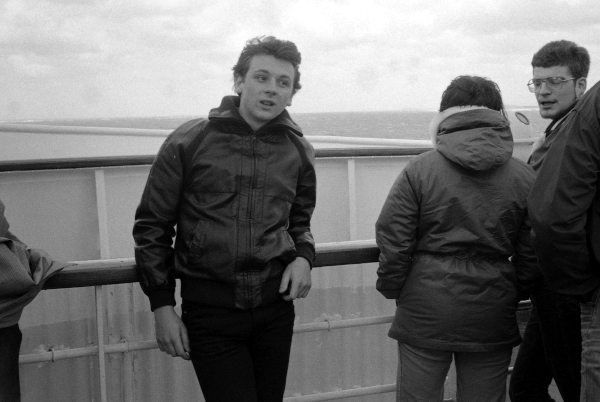
On deck
In October 1981, during the final year at my secondary school, we went on a one-week journey to England, "we" being a few dozen of students and several teachers. These students all had English among the subjects for their final examinations. In those days, somewhere halfway secondary school, when you were about fifteen years old, you had to choose a number of subjects (six, seven, sometimes eight) for the remaining few years and could "drop" all other subjects done theretofore. In my case, I chose physics, chemistry, mathematics, economics, English, and Netherlandic. Among the topics I dropped were, for instance, biology and geography, both of which I had a "10" for on my last report, on a scale to 10 whereon the 10 is reserved for God as one used to say then.
I hated trips like this and would much rather not have gone, but it was something one could not avoid. It was one of those things, the prospect of which spoils one's life many months beforehand. I took my camera with me, and some of the photos I took can be seen in a video I would make thirty-nine years later.
We went by boat from Vlissingen (Fleeshings) to Sheerness, after first travelling from Helmond to Vlissingen by bus. It was a rainy and stormy Sunday morning, and the wind force was 7 Beaufort at sea. This boat journey was the best thing about the whole trip. Due to the hard wind, it took twelve hours, and many passengers became seasick underway. The aroma of vomit was omnipresent. Unlike what we expected, the ferry did not cross straight to England but remained within sight of the Netherlandic and Belgian coasts for hours, then turned right, and soon thereafter we saw the English coast, which we again followed for hours. It was long dark before we arrived, so we saw the lights of towns on the coast during the last part of the journey.
With a few class mates I walked around the boat through the wind and rain, and we discovered that the best place to be was at the rear end, where you were out of the wind and the deck went up and down many metres with the waves. This made most people sick, so it was not too crowded there. We also came across a casino somewhere inside the boat, if I remember correctly. In the evening we had dinner in the restaurant. Meanwhile the weather had calmed down, but still one of us suddenly vomited on his plate while we were waiting to be served.
Once in the harbour we passed through customs and were taken by bus to the town of Guildford, where we stayed in pairs with families. I was paired to someone named Benny, and we were assigned to a family with two children of primary-school age.
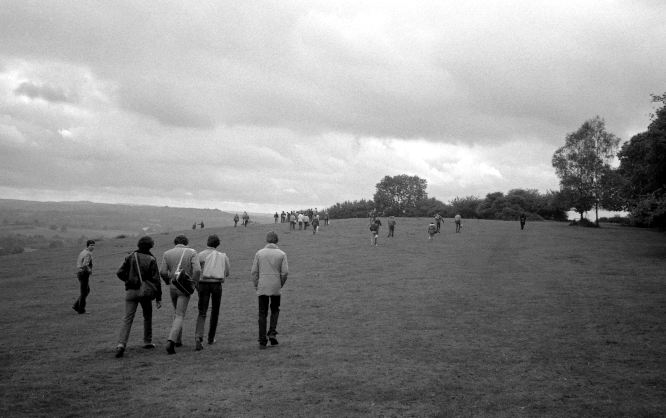
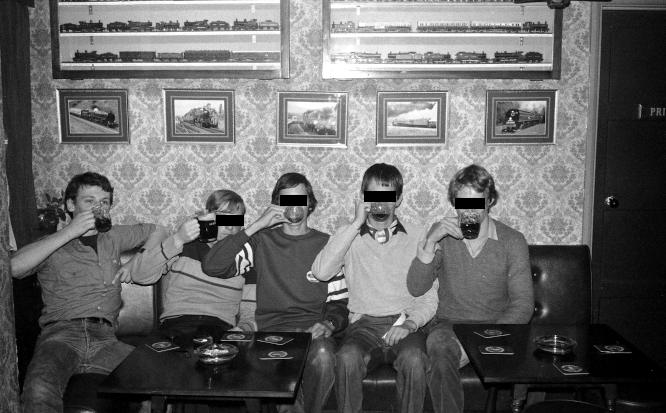
The next day we took a walk around Guildford and its hilly surroundings, getting lost about four times thanks to the navigation skills of two teachers. In the evening Benny and I attended two pubs, although we were officially a few years too young for that. The father of the host family drove us to the town centre; he had the habit of releasing the clutch abruptly without noticeably lifting his right foot, so that the car jumped forward with every gear change. "Do all people drive like this in England?" asked Benny, pointing at the clutch pedal. "By us in Holland they let it loose slowly." In the first pub we were the only Netherlanders, and I ordered half a pint of Guinness, which cost 33 pence. Then we walked to another pub, The Three Pigeons, where we met some of the others, who were drinking bitter, and we stuck to that from then on. Finally we all went to a third pub, The Spread Eagle, and that is where we would go the rest of the week. Later the father collected us by car, and, hearing I had drunk Guinness, told us that Guinness was very fattening.
On Tuesday we were driven to London by our bus, which was incidentally called "coach" there. After some delay we arrived and drove around the city for a while to see a number of famous places. Then we got out and walked to Trafalgar Square, where the large amount of pigeons struck us. We decided that these birds must be the reason that every Englishman carries an umbrella. One of our accompanying teachers allowed the doves to sit on him while he fed them.
Then we continued on foot to Picadilly Circus, where the huge wall of advertisements stood out; Philips was the first I noticed. We went to the toilet in the Underground station and did some shopping and visited a pub near the Circus. I was on my own for about an hour there, because while I was using the Underground toilet the others took off to the shops and left me. I suspect this happened because I was the only one who washed his hands after urinating, thus taking more time. When I finally found them back, they had not missed me yet. We also took a walk through Soho and came by the Marquee Club, a famous music venue. It was closed, but the pigeon teacher managed to speak to its staff and arranged that we were allowed in to have a look. We saw the tiny stage, where one was installing the equipment of the Steve Miller band for that night's concert. This teacher was a music lover and told us he had some four hundred long-playing records at home. "Once you have two hundred, it starts getting interesting", he said. I believe we also briefly attended a small bookmaker's shop on this day, where one asked us if we wanted to make much money, which we declined. From there we went on to the British Museum, where we spent the remaining time for that day and rested a bit. I remember us standing or sitting in the street opposite the museum, waiting for the coach to take us back to Guildford again, and like the day before we went to the pub in the evening.
Brighton was our goal for Wednesday. This involved a drive through a hilly landscape. Halfway we stopped for lunch at a pub on top of a steep hill, where we saw someone with a hang-glider ready to take off. Seeing that we were observing him, he changed his mind and stayed on the ground. We walked down the hill for a while in the cold and fog, and then back up again to the coach. The beach of Brighton was almost deserted. Officially we visited the Royal Pavilion, of which I seem to have no memory so it may be that I and a few others chose not to participate in that excursion but did something else instead, and we ate in a Wimpy restaurant. Wimpy was a chain of hamburger restaurants named after the Wimpy character in the Popeye cartoon. We also went to the pier, which offered a large collection of gambling machines. I remember a machine where you could test your strength by pushing a bull's horns together, which I did, and a ghost train, which I rode. The beach was covered with little stones that were awkward to walk on and made much noise. We saw a marina at some distance, but when we arrived there discovered it had a high admission fee so we did not enter. After returning to Guildford we went to the pub again.
This morning we saw Windsor Castle, where we had to act like we were only fifteen years old to get a reduced entrance fee (but it may be that I am confusing Windsor Castle with the Royal Pavilion in Brighton though). All of our bags were examined by security personnel, to prevent terrorist attacks we presumed. Soon we were done and walked around Windsor for a while. In the afternoon we would attend the musical Evita in the Prince Edward theatre in London; tickets were eight pounds. While in London, I remember we also went to McDonald's; since I was not hungry I only ordered cola, and was subsequently put out of the place to finish the drink in the street. My order had not reached the minimum amount to be allowed to stay in.
After the musical we took an evening walk through Soho and were then picked up by the coach at Trafalgar Square to be taken to Guildford. That night we stayed home, and a friend of the family was visiting. I think we were offered a type of liquor by our host on that occasion, which we accepted. Later in our bedroom — although it may have been on one of the earlier evenings — Benny complained that I never said or asked anything by myself to the English but only responded to what he or they said. Another thing he said was that I had been talking in my sleep the night before, which I did not believe.
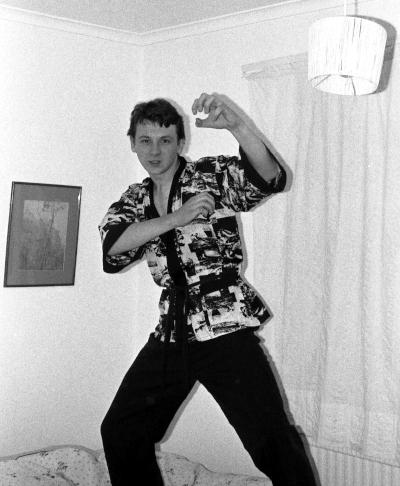
Friday was our last day in England, and Benny and I gave the family a few presents we had brought. Now it is so that I had not particularly liked the food we had got that week, even though the mother of the family was a cooking teacher (those are the worst, in my experience; if you ever meet one, run away). For example, one day we had been given Brussels sprouts to eat. Normally I have no problem with Brussels sprouts, and I even like them when they are good ones, but these sprouts had been the size of tennis balls with the consistency of reinforced concrete.
Another time we had been asked if we would like tea. Ignorantly, I had agreed. The next moment, a large beaker filled with lukewarm milk was put in front of me. Admittedly, it may have contained one or two drops of actual tea. Apparently, when the English say tea, they mean milk?! I had been given absolutely no chance whatsoever to say I did not want milk. We had got milk with cornflakes in the morning too a few times. The cornflakes were not bad, but the milk spoiled it.
And on this last morning, just when I thought I was forever rid of English food, she took us to the kitchen and said she had prepared a special Scottish breakfast for us. Trembling with fear we sat down and were served two bowls of porridge. While the mother left the kitchen and we attempted to get it down, Benny whispered to me, "This is like the mush they give to babies in the Netherlands."
Finally, we went to the Civic Hall, where all the students, teachers, and host parents came together to say goodbye. From there we drove to London, where we admired the Kew Gardens (tickets were ten pence). Then we took the Underground to the centre of London, or so we thought. After minutes though, we realized it was a regular train heading out of town instead of an Underground. Somewhere in the north of London we got out and took the real Underground back to the centre. When exiting the train, we noticed with amazement that the voltage was seemingly delivered through rails on the ground rather than lines above the train like in the Netherlands. In hindsight though, I am not fully certain if that observation was correct. It did lead us to conclude that England was a dangerous land for people who like to put their ear to the rails to listen if a train is approaching.
I remember we left the Underground at Leicester square and walked from there to Picadilly Circus, where we shopped until the coach took us to a restaurant for our final meal in England. I did not buy much during this week; only two pins, of Van Halen and AC/DC. Disaster almost struck when I went to the restaurant toilet: the door would not open and I was locked in for a few minutes, fearing one would leave without me again. Eventually I succeeded in opening the door, just in time to get on the bus to the harbour of Sheerness. We had the night boat this time, and the sea was calm. To our disappointment, the teachers would not allow us to roam around all night but made us stay in the sleeping compartment, where we each had our own numbered seat. I had to wake up and remove another passenger who was clandestinely occupying mine. Once in the seat, I could not sleep. How can a sixteen-year-old fall asleep in a chair?! It turned out almost all could, which astounded me because I am a very awake person and chronically shocked by the lack of awakeness in others.
At a quarter to six in the morning — Saturday meanwhile — a man with a hammer woke everyone up who was still sleeping, and it was time for breakfast in the restaurant of the boat. We also raided the on-board tax-free store, where I remember seeing a bottle of Ballantines whiskey for eight guilders. Before long, Vlissingen was reached; I believe this was after only eight hours this time, while the crossing in the other direction had taken twelve. The bus drove us home, or rather to Helmond, where our school was. Three days later I wrote a short essay about the journey — an assignment of our English teacher — which, together with the photos and negatives, enabled me to write this biographical note in a mostly correct chronology. Some additional information came from another, longer, essay written months later. As an aside, it is good mention here that negatives, inherently, contain the exact chronological order of the photos, and that I had a darkroom in the attic of my parental house at the time, where I developed and printed the photos myself.